Why Start a Fire in the Gulf When You Need It to Win the AI Race?
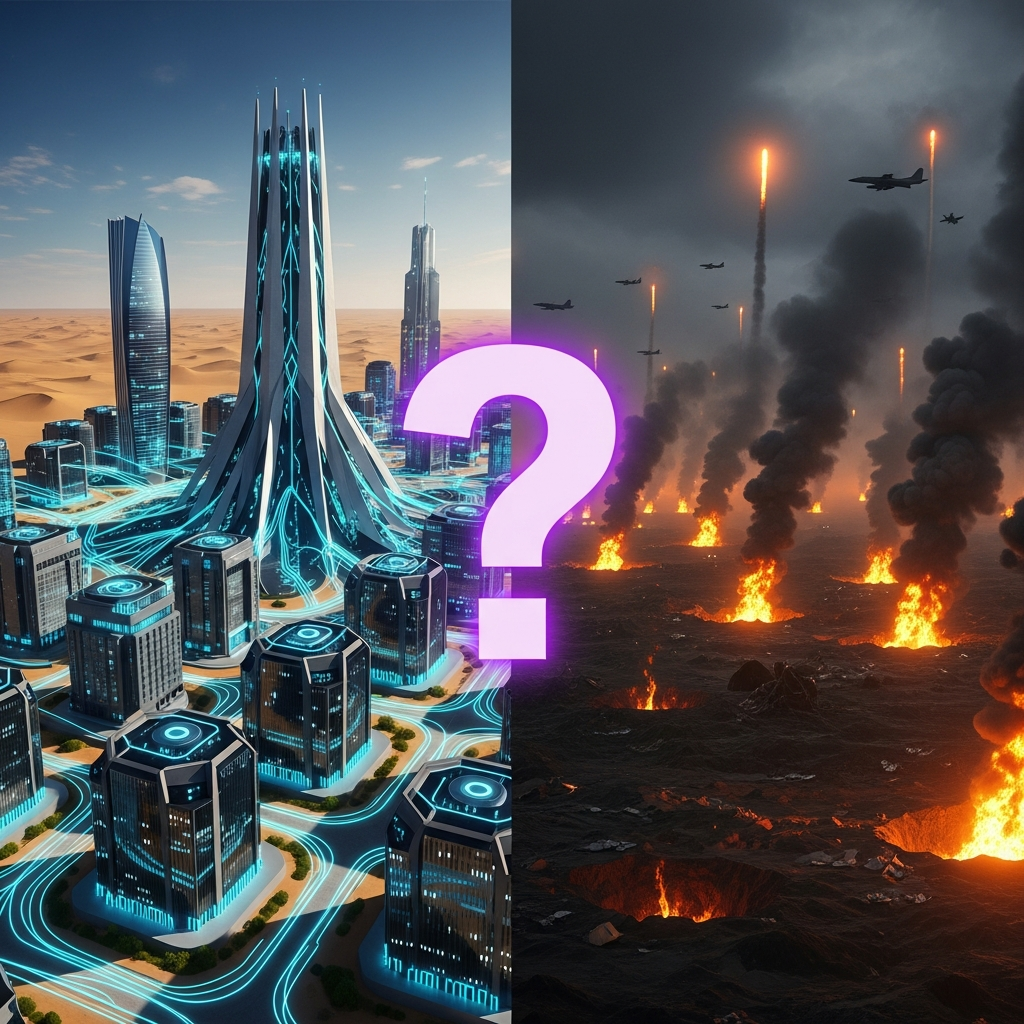
Why Start a Fire in the Gulf When You Need It to Win the AI Race?
The US is pursuing data center deals in the Gulf worth billions to power AI infrastructure. Meanwhile, it's helping Israel bomb Iran. These two strategies make no sense together, unless we're missing something critical.
The Paradox
Here's what doesn't add up.
The US is in the middle of an AI arms race with China. And the critical bottleneck isn't chips, it's data centers. The US domestic grid is maxed out: power plants take a decade to build, transmission lines eight years, and electricity costs four times more in Texas than in the Gulf.
The solution? Go where the power is cheap.
In 2025, the US and UAE unveiled a 5GW AI campus, the largest outside America. Saudi Arabia signed $600 billion in tech deals. Microsoft committed $15.2 billion to the UAE. Google put $10 billion into Saudi AI hubs. The Gulf is being positioned as the exit ramp for America's compute crisis.
This is the US's strategic counter to China in the inference race. If AI shifts to who can scale inference cheaply, the Gulf is where America wins.
And then there's Iran.
On February 28, 2026, the US joined Israel in bombing Iran. The Strait of Hormuz, the world's most critical oil chokepoint, got closed. For a region where you're trying to build the most expensive infrastructure in human history, this is existential risk.
Why would you light a fire in the house you're trying to renovate?
Iran Struck First
On March 1, 2026 — just days after the US bombing started — Iranian Shahed drones struck two Amazon Web Services data centers in the UAE and a third in Bahrain. The attacks forced facilities offline, causing banking outages, payment failures, and enterprise software disruptions across the region.
This wasn't collateral damage. This was intentional.
Iran's IRGC subsequently named 18 US tech giants as "legitimate military targets" and released a list of 30 locations across the Gulf — offices in Dubai and Abu Dhabi belonging to Oracle, Google, Microsoft, Amazon, Nvidia, IBM, and Palantir — designated as "enemy technology infrastructure."
In early April, debris from an intercepted Iranian projectile struck an Oracle office building in Dubai Internet City.
Iran knows exactly where the data centers are. They're hitting them on purpose.
The Question We're Asking
This article isn't going to give you answers. It's going to give you questions.
Because the more we researched this, the less the dots connected. And that's strange. When strategic interests align this clearly, the lack of a connection is worth investigating.
So here are the questions we couldn't answer:
1. Did Venezuela Create Dangerous Overconfidence?
In January 2026, the US pulled off a military operation in Caracas, arrested Nicolas Maduro, and secured an oil deal worth $2 billion. Fifty million barrels redirected from China to the US. It was fast, decisive, and it worked.
This was a proof of concept: regime change + oil secured. The playbook exists.
If Maduro worked, why not Iran? The short-term oil disruption would be mitigated by US shale (at peak production: 14 million barrels/day) and the Venezuelan spoils. Plus, removing Iranian missiles removes the threat to the very Gulf data centers the US is trying to build.
Maybe this felt like a feature, not a bug?
2. Did Netanyahu Go Behind Trump's Back?
Here's what's interesting. On February 11, 2026, Netanyahu and Trump met for three hours. They agreed to "close coordination." But reporting from late 2025 shows a split: Netanyahu wanted direct military action while Trump wanted negotiations.
Sixteen days later, the bombs started falling.
Was this "close coordination" — or did Netanyahu push a war Trump didn't want, forcing the US to tag along? By the time the US was in, it was too late to pull back. A hard Hail-Mary that now seems to be backfiring: the Strait of Hormuz has been opened and closed multiple times, oil prices are volatile, and the Gulf stability the US needs for its data centers is in question.
3. The Double Bind
Either option is troubling:
-
If Trump authorized this: He believed he could protect a $15B+ data center play by bombing the region those data centers depend on. That's either brilliant or catastrophically naive.
-
If Netanyahu pushed this: The US got dragged into a war that serves Israeli interests but threatens the single most important piece of America's AI infrastructure strategy. That's either loyal alliance or strategic betrayal.
We can't find evidence for either. But at least one seems to be true.
What We Do Know
Some things are clear from the research:
-
The US has real domestic constraints. Power shortages, land permits, grid capacity. These aren't being solved fast enough to meet AI demand.
-
China has an energy advantage. China added more electricity generation in 2024 than the US has in a decade. If the AI race becomes about inference scale, China wins on cost.
-
The Gulf is the counter. Cheap energy, strategic location, submarine fiber cables connecting to Mumbai, London, Nairobi, Singapore. The US is betting big here.
-
China doesn't want prolonged war. Beijing privately pressured Iran toward a ceasefire. Oil price shocks hurt an export-dependent economy. The Gulf partnerships matter to China too.
-
Iran is targeting data centers. The March 1 AWS attacks were deliberate — not collateral damage. Iran knows the AI play and is attacking it directly.