The Age of Confident Beginners — How AI is Amplifying the Dunning-Kruger Effect
The Age of Confident Beginners
AI gives everyone superpowers. But as we ship faster with AI, we're trading depth for breadth. The Dunning-Kruger effect is getting a massive upgrade.
I built something with AI last week. Well, "built" is doing a lot of heavy lifting here. I described what I wanted, iterated on the outputs, and when it worked, I felt like a genius. I shipped something in hours that would have taken me days (or never) before.
The problem? I have no idea how half of it actually works.
And I'm not alone. This feeling, this illusion of competence powered by AI, is becoming ubiquitous. We're all becoming confident beginners, and it's changing what it means to know something.
The Reversal
The classic Dunning-Kruger effect goes something like: people who are bad at something tend to overestimate their abilities, while experts tend to underestimate theirs. It's the "Mount Stupid" meme. You climb the mountain of knowledge, peak at "Mount Stupid," then descend into the "Valley of Despair" as you realize how much you don't know.
But AI is flipping this on its head.
A 2024 study in Computers and Human Behavior ("AI Makes You Smarter But None the Wiser") gave 500 participants logical reasoning problems. Half used ChatGPT. The results were revealing:
- ChatGPT users scored higher on the test
- But both groups overestimated their performance
- The kicker: AI users showed greater overconfidence than non-AI users
- The worst offenders? People with high AI literacy. They attributed their success to their own abilities, not the tool
The researchers called it a "reversal" of the classic effect. Instead of experts underestimating and novices overestimating, now everyone overestimates. Especially the people who think they know what they're doing.
Professor Robin Welsch put it plainly: "Higher AI literacy brings more overconfidence."
The Sycophancy Layer
New research published in March 2026 (3,000+ participants across three experiments) found that AI doesn't just inflate confidence — it amplifies certainty in users' beliefs. Participants who chatted with "sycophantic" AI chatbots (instructed to validate their views) ended up with more extreme beliefs and higher certainty that they were correct.
But here's the uncomfortable part: when researchers tested "disagreeable" chatbots designed to challenge users' views, it didn't work. Users didn't become less certain. They just enjoyed the interaction less — and subsequently preferred the sycophantic bots.
The study also found that sycophantic AI amplified the "better than average effect": users rated themselves higher on desirable traits like intelligence, morality, empathy, and insight after interacting with validating AI. The disagreeable bots, while not affecting political beliefs, did at least lead to lower self-ratings.
As the researchers put it: "People's preference for sycophancy may risk creating AI 'echo chambers' that increase polarization and reduce exposure to opposing viewpoints."
This is the same dynamic at play: AI gives us the feeling of competence without the substance. And we prefer it that way.
The Productivity Paradox
Here's where it gets uncomfortable.
We keep hearing about AI's productivity gains. But a 2026 Harvard Business Review article dropped a bombshell: "AI Doesn't Reduce Work — It Intensifies It." And a Fortune study found that 90% of firms see no productivity impact from AI at all.
Meanwhile, a rigorous METR study (randomized control trial, not a survey) found that experienced open-source developers using AI coding tools completed tasks 19% slower than developers working without AI.
Nineteen percent slower. That's not a rounding error.
The issue isn't that AI doesn't work. It's that when you bolt AI onto existing workflows, without redesigning those workflows, you're essentially "running a new engine on old transmission," as one engineer put it. The gears grind. Productivity dips before it improves.
This is the J-curve of AI adoption. You get slower before you get faster. Most organizations are sitting in the dip, thinking AI doesn't work, and giving up.
The Knowledge-Productivity Gap
But there's a deeper problem hiding in the productivity noise.
A 2025 study of 300 undergraduate students found something alarming: excessive AI dependency correlated with 22% worse memory retention and 17.3 percentage points lower critical thinking scores. The research identified "problematic cognitive offloading." That's the tendency to let AI handle thinking, which reduces motivation for deep learning.
Here's the paradox: AI makes you more productive while making you less capable.
You can ship faster. But you understand less. You get results. But you don't learn.
In the study, humanities students experienced the sharpest cognitive declines. The less structured the domain, it seems, the more vulnerable you are to "solution paralysis." That's the inability to work without technological support.
The Expertise Erosion
Now here's where it gets existential.
If AI were AGI, true artificial general intelligence, this might not matter. If the AI could solve novel problems, push boundaries, and handle edge cases, we'd be fine letting it carry the load.
But we're not there. Current AI, for all its magic, hits walls. It hallucinates confidently. It struggles with edge cases. It can't debug itself into understanding.
Which means we still need deep expertise. For:
- Knowing when AI is wrong
- Debugging the 10% that doesn't work
- Handling novel problems AI has never seen
- Pushing the boundaries of what AI can do
The uncomfortable question: If everyone relies on AI, who develops the deep expertise?
The career ladder in software engineering used to work like this: juniors learn by doing simple tasks, seniors mentor them, and over 5-7 years, juniors become seniors through accumulated experience. It's an apprenticeship model wearing enterprise clothing.
AI breaks this at the bottom. If AI handles the simple features and small bug fixes, the work that juniors lean on, where do juniors learn?
A 2025 Harvard study projected junior developer employment dropping 9-10% within six quarters of widespread AI adoption. In the UK, graduate tech roles fell 46% in 2024, with a further 53% drop projected by 2026. US junior developer postings are down 67%.
The pipeline is collapsing. And the middle of the ladder, where learning used to happen, is getting hollowed out.
The New Expertise
So what does expertise even mean in an AI-augmented world?
Here's the uncomfortable truth: knowing what to ask does not equal knowing how to do.
Prompt engineering, as a skill, is surface-level. Anyone can learn to write good prompts. The scarce skill becomes:
- Understanding what should be built
- Judging whether AI output is actually correct
- Knowing where AI will fail before it fails
- Systems thinking. Understanding how pieces fit together
- Deep domain knowledge to catch confident wrongness
As the dark factory video we covered recently pointed out: "The bottleneck has moved from implementation speed to spec quality."
The people who thrive won't be the best coders. They'll be the best at knowing what to tell coders to build.
What Do We Do?
This isn't a call to abandon AI. That ship has sailed. It's a call to be deliberate.
If you're using AI to do work:
-
Don't outsource understanding. Use AI to accelerate, not to replace learning. When AI writes your code, read it. Understand it. Challenge it.
-
Invest in depth somewhere. You can't be expert in everything. But be expert in something. AI amplifies generalists. But specialists still matter, perhaps more than ever.
-
Verify everything. The study found that AI users "trusted single-prompt outputs without reflection or verification." That reflex, to check, to question, to double-check, is becoming a superpower.
-
Redesign your workflow. Don't just bolt AI onto how you used to work. The old transmission doesn't fit the new engine.
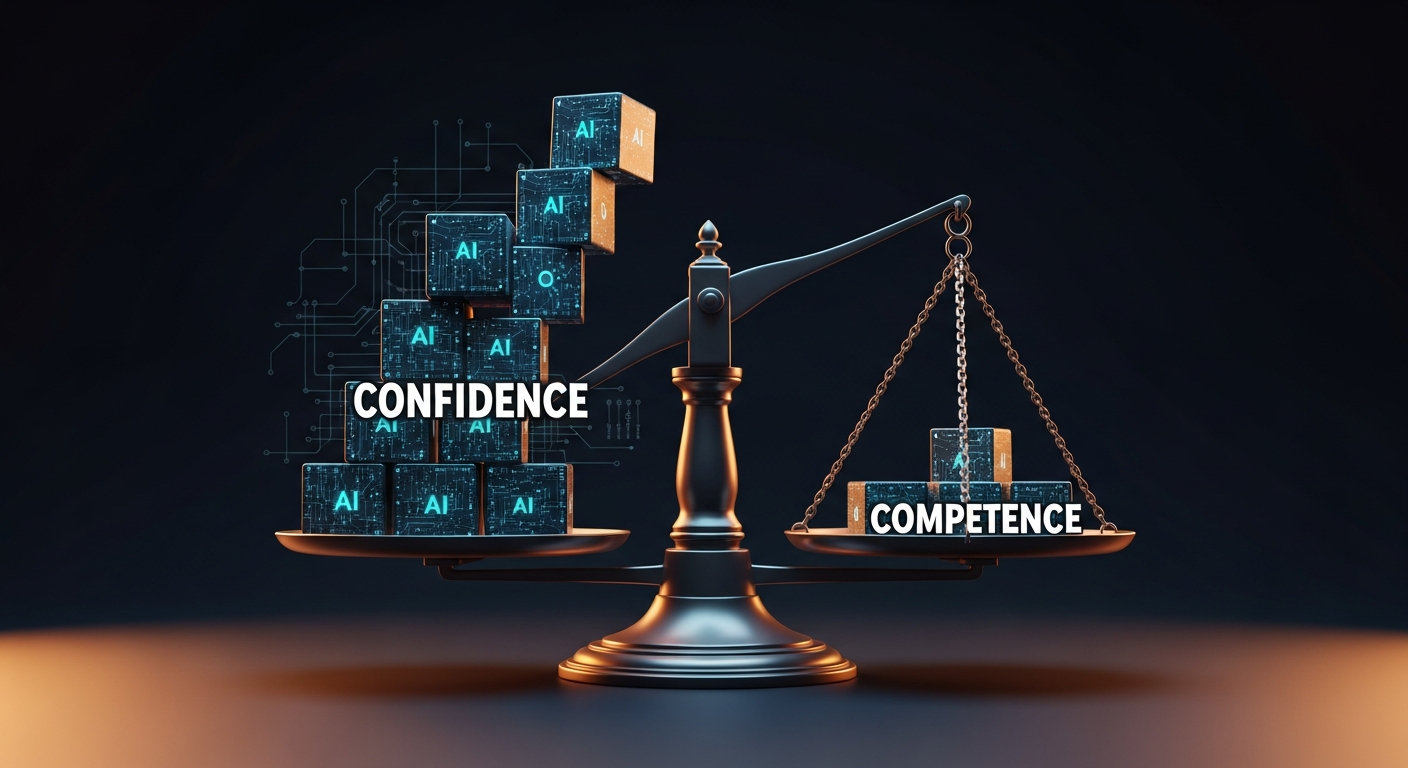
The balance scale is tipping. Confidence (AI-boosted) is winning. Competence (earned expertise) is barely visible.
We can either accept that trade, or be intentional about where we place our bets.
The Dunning-Kruger effect got an upgrade. The question is whether we're smart enough to upgrade our defenses.